Our Approach
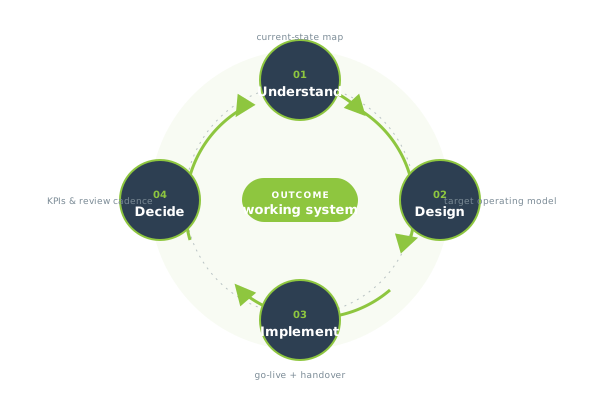
Four steps from first conversation to a working system your team owns. No mystery framework, no jargon — just the discipline that keeps engagements on track.
Why this method, in this order
We've watched enough engagements fail to know where they fail: assumptions made without floor data, recommendations written without operator input, and implementations handed to a team that wasn't part of the design. So we work in this sequence specifically — and we don't skip steps.
The output of each step is the input to the next. Discovery feeds design; design constrains implementation; implementation defines the metrics that prove the change worked. Anything else is a slide deck.
Step 1: Understand the operation
We start on site, not in a boardroom. Walk the floor, shadow shifts, sit with the planners, talk to the auditor who failed the last surveillance. Pull data from the ERP, the SCADA historian, the LIMS, the time-and-attendance system — whatever exists. The deliverable is a current-state document the operations manager recognises as their plant, with the bottlenecks ranked by impact.
Discovery Activities
- Stakeholder interviews and workshops
- Current state process mapping and documentation
- Data flow analysis and system architecture review
- Performance metrics baseline establishment
- Risk assessment and compliance evaluation
- Technology infrastructure audit
Problem Identification Framework
Observed symptom
Downtime, late orders, audit findings
Floor data
ERP, MES, historian, interviews
Root cause
Verified against the data, not opinion
Quantified opportunity
Sized in rands before any build starts
From observed symptom to root cause — structured so the recommendation isn't a guess.
Step 2: Design for your context
Solution design happens jointly with the people who will run the system. We work to your real constraints — existing kit, regulatory regime, team skills, capex envelope — and avoid recommending a green-field rebuild when a focused change will achieve 80% of the gain. Each design choice is documented with the trade-off explicit, so you can challenge it before any code or paperwork gets generated.
Solution Design Process
- Future state process design and optimization
- Technology architecture planning and selection
- Integration strategy development
- Change management planning
- Risk mitigation strategy design
- Success metrics and KPI framework definition
Solution Customization Workflow
Requirements Analysis
Define functional and technical needs
Solution Architecture
Design system and process framework
Validation & Testing
Prototype and validate approach
Refinement
Optimize based on feedback
Step 3: Implement together
Implementation is run as a joint team. Your operators, planners and engineers are inside the build — not on the receiving end of a hand-over — because the system has to keep running on the next shift, after we're gone. We document everything we touch, train against the actual system rather than slide-ware, and define explicit handover criteria the project sponsor signs off.
Implementation Support
- Dedicated project management and coordination
- Comprehensive training programs for end users
- Change management and communication strategies
- Phased rollout planning and execution
- Real-time support during transition periods
- Knowledge transfer and documentation
Collaborative Implementation Steps
Joint build
Your operators inside the project team
Train on the real system
Working screens, not slide-ware
Handover criteria
Documented, testable, agreed up front
Sponsor sign-off
The engagement ends when you say it works
Step 4: Decide on data
We instrument what we build. KPIs are agreed before go-live, dashboards are deployed alongside the change, and a review cadence is set with named owners. The point isn't pretty charts — it's that the operations review meeting next quarter has the numbers to keep improving without us.
Analytics & Monitoring
- Real-time dashboard development and deployment
- Key performance indicator (KPI) tracking systems
- Automated reporting and alert mechanisms
- Trend analysis and predictive insights
- Regular performance reviews and optimization recommendations
- Continuous improvement framework establishment
Data-Driven Decision Flow
Data Collection
Automated data gathering from systems
Analysis
Real-time processing and insights
Visualization
Dashboards and reports
Action
Informed decision making
Optimization
Continuous improvement
What this gets you
Fewer surprises mid-project
Risks surface during discovery, not during cut-over. Each design choice carries a documented trade-off you signed off — so there are no late "we didn't know that" moments.
Operators on board from day one
The people who run the system helped design it. Adoption isn't a change-management problem we layer on at the end — it's built into the engagement from the first interview.
Outcomes you can measure
KPIs are agreed before go-live and instrumented at delivery. You can prove the change worked — or catch it early if it didn't.
A system that survives our exit
Documentation, training, runbooks and clear handover criteria. Your team owns the result — not a dependency on us.
Want to see how this fits your operation?
Book a free 30-minute call. Bring the bottleneck you'd like to solve — we'll walk through how the four steps would apply to it, and what a likely first engagement looks like.
Book a Free Discovery Call